
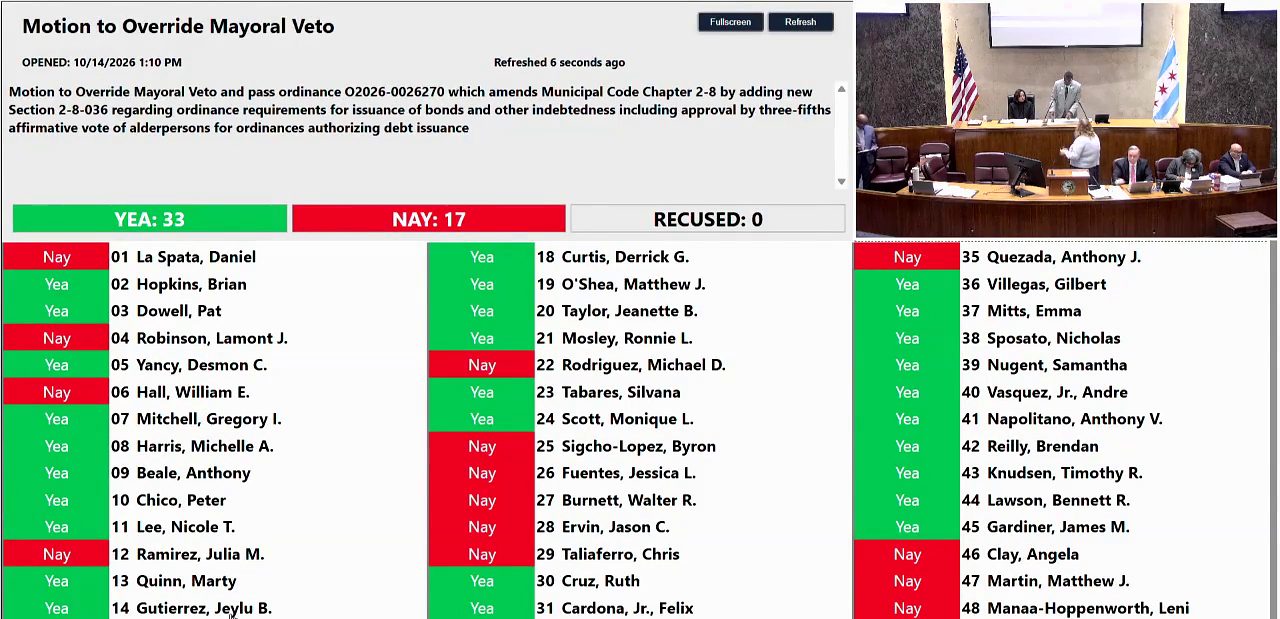
The Chicago City Council fell one vote short on Oct. 14 of overriding Mayor Brandon Johnson's veto of a measure that would have made it harder for the city to borrow money. The override failed 33 to 17, and supporters needed 34 votes, the Chicago Sun-Times reported.
What the measure would have done
The ordinance, sponsored by Ald. Marty Quinn (13th), would have required a three fifths vote of the Council, or 30 votes, to approve future city borrowing. Today the threshold is a simple majority of 26 votes. The Council's record of the Oct. 14 meeting shows the final tally as 33 yeas and 17 nays, and the presiding officer announced, "This motion fails."
How it got there
On Sept. 29, the Council voted 32 to 15 to set the 30 vote threshold, three votes short of the 34 needed to survive a veto, CBS Chicago reported. CBS reported that debt payments and employee pension obligations make up about 40 percent of the city's annual operating budget. Johnson vetoed the measure. It was his fourth veto and Quinn's second failed override attempt, the Sun-Times reported.
What the aldermen said
Quinn said on Sept. 29 that using "a three-fifths vote as opposed to a simple majority allows more voices to be heard and counted," according to CBS Chicago. Ald. Bill Conway (34th) said the city's debt load "is really a silent killer on our budget," and that the risk is "becoming too tied up in paying the interest on the taxpayers' credit card that will crowd out our ability to fund parks, and schools, and roads, and police officers, and mental health clinics," CBS reported.
On Oct. 14, Conway said the claim that requiring 30 votes "will somehow delay infrastructure investment simply doesn't square with the facts," the Sun-Times reported. Ald. Jason Ervin (28th), a close ally of the mayor and chair of the Budget Committee, said, "Nobody gives away power and I didn't come down here to give up mine." Earlier, when the ordinance cleared the Finance Committee, Ervin argued that "to allow a minority of members to effectively hold everybody hostage, I don't think is in the best interests not only of the city, but of how democracy works," CBS reported. Johnson said, "Last I checked, 26 votes is still a majority, and that still exists." He has argued that bonds are a necessary tool to boost development in neighborhoods on the South and West sides, according to CBS.
The debt behind the debate
The Civic Federation reported that the city's net outstanding debt rose 32.8 percent, from $22 billion in fiscal 2014 to $29.2 billion in fiscal 2023, according to Hoodline. The Civic Federation also reported that the city's debt service ratio averaged 19.4 percent from fiscal 2021 through fiscal 2025.
Last year the Council nearly blocked an $830 million general obligation bond issue whose back loaded repayment schedule raised the total cost to $2 billion, the Sun-Times reported.
Also on Oct. 14
The Council made the Smart Streets bus and bike lane camera program permanent and citywide, and approved a $260.8 million settlement tied to former detective Reynaldo Guevara. Read our stories on both.
Our question
Should it take 30 votes to borrow, or are 26 enough? Tell us on TikTok, YouTube or Instagram, or write to contact@reofact.com.
Photos and video: ReoFact.